

Sunday, August 15, 2010

Sunday Youtube Post
So apparently Republicans manufactured another fake controversy during my week without news. Not only are they trying to get the 14th Amendment repealed (as an ultimate sign of love towards their precious Constitution), now they're making up stories about "terror babies" to scare the shit out of their supporters into following along. Terror babies. I did not make up that phrase. Terrorists are sending pregnant women into America so that when the babies grow up, they'll have U.S. citizenship and attack America as UNITED STATES CITIZENS! Because as everyone knows, if a terrorist isn't a citizen of the country he's attacking, his superpowers disappear!
Friday, August 6, 2010
Friday Youtube Post
I'm leaving for Michigan tomorrow and won't be back for a week, so here's the weekly youtube. This is just as true today as it was twenty-six years ago. I can't believe how hard Reagan fucked this country.
"I feel like I don't live in America."
"With or without religion, you would have good people doing good things and evil people doing evil things. But for good people to do evil things, that takes religion."
-Seven Weinberg
I'm reading a book right now called The End of Faith where Sam Harris makes an argument against religious moderates. He says that even though the moderates mean well, their constant repeating of "not all of [religion] is violent" prevents us from having a dialogue about the central cause of all religious terrorism: religion.
I think this is the biggest problem we have with the gay marriage issue. There are even religious moderates, all over the place, who are otherwise perfectly moral and sane, who do not believe gays should be allowed to marry. Many religious people who support same sex marriage, or at least the hollow equivalent of civil unions, at the very least sympathize with where the gay marriage opponents are coming from; and this really does prevent us from criticizing anti-gay bigots to the fullest extent. There is no excuse to opposing gay marriage. That worldview really shouldn't be tolerated. An opinion's worth should be weighed with how much logical validity it contains, and in logical terms, the ideas of these people make absolutely no sense. There is no valid argument against same sex marriage. If a bad idea makes no sense, then it should be thrown out and laughed at like the disgrace it is, not blasted on the airwaves as if it holds just as much weight as logical facts. If every opinion was equal, we would be teaching creationism and flat earth theory in public schools. America's public discourse is an embarrassment.
Here's what I mean: these are the opinions of people who oppose same sex marriage. This is their reaction to Prop 8 getting overturned. I can't even wrap my head around this. I can't possibly comprehend how any person could ever believe this shit.
From a Mormon forum:
-Seven Weinberg
I'm reading a book right now called The End of Faith where Sam Harris makes an argument against religious moderates. He says that even though the moderates mean well, their constant repeating of "not all of [religion] is violent" prevents us from having a dialogue about the central cause of all religious terrorism: religion.
While moderation in religion may seem a reasonable position to stake out, in light of all that we have (and have not) learned about the universe, it offers no bulwark against religious extremism and religious violence. From the perspective of those seeking to live by the letter of texts, the religious moderate is nothing more than a failed fundamentalist. He is, in all likelihood, going to wind up in hell with the rest of the unbelievers. The problem that religious moderation poses for all of us is that it does not permit anything very critical to be said about religious literalism. We cannot say that fundamentalists are crazy, because they are merely practicing their freedom of belief; we cannot even say that they are mistaken in religious terms, because their knowledge of scripture is generally unrivaled. All we can say, as religious moderates, is that we don't like the personal and social costs that a full embrace of scripture imposes on us. This is not a new form of faith, or even a new species of scriptural exegesis; it is simply a capitulation to a variety of all-too-human interests that have nothing, in principle, to do with God. Religious moderation is the product of secular knowledge and scriptural ignorance--and it has no bona fides, in religious terms, to put it on a par with fundamentalism. The texts themselves are unequivocal: they are perfect in all their parts. By their light, religious moderation appears to be nothing more than an unwillingness to fully submit to God's law. By failing to live by the letter of the texts, while tolerating the irrationality of those who do, religious moderates betray faith and reason equally. Unless the core dogmas of faith are called into question--i.e., that we know there is a God, and that we know what he wants from us--religious moderation will do nothing to lead us out of the wilderness.
I think this is the biggest problem we have with the gay marriage issue. There are even religious moderates, all over the place, who are otherwise perfectly moral and sane, who do not believe gays should be allowed to marry. Many religious people who support same sex marriage, or at least the hollow equivalent of civil unions, at the very least sympathize with where the gay marriage opponents are coming from; and this really does prevent us from criticizing anti-gay bigots to the fullest extent. There is no excuse to opposing gay marriage. That worldview really shouldn't be tolerated. An opinion's worth should be weighed with how much logical validity it contains, and in logical terms, the ideas of these people make absolutely no sense. There is no valid argument against same sex marriage. If a bad idea makes no sense, then it should be thrown out and laughed at like the disgrace it is, not blasted on the airwaves as if it holds just as much weight as logical facts. If every opinion was equal, we would be teaching creationism and flat earth theory in public schools. America's public discourse is an embarrassment.
Here's what I mean: these are the opinions of people who oppose same sex marriage. This is their reaction to Prop 8 getting overturned. I can't even wrap my head around this. I can't possibly comprehend how any person could ever believe this shit.
From a Mormon forum:
- May the Lord have mercy on us. He spared Sodom & Gomorrah (edited to add: for awhile), so perhaps He will spare California. I almost wouldn't mind if He didn't.
- This is a camel's nose in the tent type situation. When the disintegration of the family is complete, except for those few peculiar die-hard religious nuts, at least many of us can look back and say that we fought to preserve the family. We know that in this dispensation there won't be another absolute apostasy. I would have hated to have been a prophet at the end of a previous dispensation when the entire world rejected your message and turned from God. The tares will separate from the wheat all on their own. Just make sure you stay wheat.
- It's also extremely problematic that Judge Walker is a practicing homosexual himself. He should have recused himself from this case, because his judgment is clearly compromised by his own sexual proclivity. The fundamental issue here is whether homosexual conduct, with all its physical and psychological risks [lol], should be promoted and endorsed by society. That's why the people and elected officials accountable to the people should be setting marriage policy, not a black-robed tyrant whose own lifestyle choices make it impossible to believe he could be impartial. His situation is no different than a judge who owns a porn studio being asked to rule on an anti-pornography statute. He'd have to recuse himself on conflict of interest grounds, and Judge Walker should have done that.
Yes, because only straight people should be allowed to decide the fates of gay people. Gay people can't be judges because they're not like us normies.
From Bishop Harry Jackson. Supporting gay rights makes you... racist?
From Bishop Harry Jackson. Supporting gay rights makes you... racist?
- This is a travesty of justice. The majority of Californians -- and two-thirds of black voters in California -- have just had their core civil right to vote for marriage stripped from them by an openly gay federal judge who has misread history and the Constitution to impose his San Francisco views on the American people. The implicit comparison Judge Walker made between racism and marriage is particularly offensive to me and to all of us who remember the reality of Jim Crow.
And the best one of all, from MSNBC:
- Luke Otterstad, 24, of Sacramento, outside the courthouse with his fiance, Nadia Shayka, 22, wearing T-shirts that read "bride" and "groom": "I'm very upset. I feel like I don't live in America."
An America that recognizes equal rights for all of its citizens is not an America I want to live in.
Thursday, August 5, 2010
Prop 8 Has Been Overturned
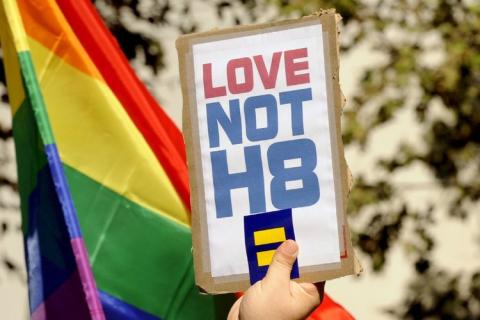
The debate over gay marriage really pisses me off. It shouldn't even be a debate anymore, since a rational argument against it simply does not exist. The same tired arguments have been debunked over and over again, and yet everyone insists on repeating them. And it works. It's infuriating. These morons are completely deaf.
Social issues are always the most prominent things on my mind when I vote, and when it comes to social issues, Republicans are downright monsters. Only a monster would gleefully deprive happiness from other people of whom he knows nothing about, and believe himself to be morally just in doing so. Although this is a huge victory for civil rights, we still can't forget all the other states where same sex marriage is still illegal. And this is likely going to go to the (extremely conservative) Supreme Court.
A couple years ago for my speech class, I wrote a speech arguing in favor of same sex marriage. I'm really passionate about this issue, and I figure this is as good a time as any to share some of this. Here's my favorite tidbits:

A couple years ago for my speech class, I wrote a speech arguing in favor of same sex marriage. I'm really passionate about this issue, and I figure this is as good a time as any to share some of this. Here's my favorite tidbits:
One of the strongest and most used arguments against same sex marriages is that it is unnatural—that it is not the way nature, or God, intended things to be. In our every day common sense thinking, it's easy to see why this is convincing. There is no natural way for a gay couple to procreate. There's no apparent use for homosexuality, evolutionarily speaking. But the same can be said of some straight marriages. Not all straight couples wish to have children. Many aren't even able to. So should we then tell those married couples that they're only together out of lust or perversion, and that their marriages are no longer valid?
The concept that homosexuality is somehow abnormal to nature is a myth. Hundreds of species engage in gay behavior, such as bears, chickens, cheetahs, penguins, whales, or gorillas. In fact, according to Bruce Bagemihl in his book, “Biological Exuberance,” among the 1,500 species of animals that have been extensively observed by humans, 450—almost one-third—of them have exhibited homosexual behavior. The range of this behavior varies from briefly exerting one's dominance, to the complete rejection of heterosexual partners (even while in heat), or even life-long pairings where the partners go so far as to adopt and raise orphans.
This brings us to another argument, that gay couples are not capable of raising a healthy child. If the critics honestly believed this, then why is there never a peep about the convicted felons, murderers, and known child molesters who are perfectly able to get married and have children, and do so every single day? There is no outrage over these scumbags raising children, on the same level of outrage over gay couples.
The claim that a child needs both a mother and a father in order to be raised correctly is also false. There have been dozens of studies on this topic, nearly all of them contradicting this claim. They show that there is no difference, whatsoever, among children raised by straight parents, and those raised by gay parents.
[...]
Anti-gay marriage proponents also argue that to allow gays to marry would open the door to other, more sinister things, such as bestiality, or incest, or polygamy. This is a classic slippery slope. Its only use is to incite fear into whoever would listen. These things are all unspeakably terrible, so we obviously shouldn't take the first step that would lead to them. If this were really true, wouldn't these things have already happened in countries where same sex marriages are legal? They're already legal in countries like Canada, Spain, and Norway. No one is demanding to be married to animals, or their own sisters, or to have multiple wives, in any of these countries.
The fact of the matter is that supporters of gay marriage are advocating for two consenting adults to be wed. Nothing else. Gay marriage opponents should stop treating them like they're the ones hoping for incest and bestiality, when these horrifying things have absolutely nothing to do with the debate.
[...]
There's also this concept that allowing gays to marry would somehow lessen the marriages of straight couples, that since it isn't the way marriages have traditionally been done in the past, it would somehow be a threat to marriages that are already legal. I personally don't see how allowing more marriages would be a threat to marriage. The main reasoning behind this traditional thinking is the Bible. The Bible says that a man shall not lie with another man, that it is an abomination. The Bible also says that God hates divorce, and yet 50% of straight marriages in America end in failure. Why is divorce legal?
This leads us to the most popular argument—that homosexuality goes against the Bible and Christian principles; and since America is a Christian nation, gay marriage should not be legal. Regardless of the fact that not all Christians agree with this interpretation, America is not a theocracy. There is nothing wrong with a person in government using the Bible as his moral compass, but making important decisions which impact the lives of others, using only one interpretation of a book which not everyone even agrees with, is not only irresponsible, it's downright un-American.
The founding fathers, while most of them were indeed Christian, still hated the idea of religion integrating into government. That's what Europe did. That was for kings. The founders were products of the Enlightenment—an age where freethinkers would strongly oppose organized religion, and would rather worship God on a more personal level, which doesn't interfere with anyone else's beliefs. Many founders, including Thomas Paine, Thomas Jefferson, and Benjamin Franklin, weren't even Christians at all, they were deists, meaning they believed in a personal creator, but not one which interacts with the affairs of the universe. George Washington himself is quoted to saying “...that national morality can prevail in exclusion of religious principle.”
I won't try to argue that the founders would support same sex marriage, because let's be honest, they wouldn't. They were products of their time, with standards and morals different than our own. In fact, on one occasion where Washington discovered that two soldiers in his army had tried to commit homosexual acts, he quickly tried them, and kicked them out.
But whether the founders themselves would or wouldn't have supported same sex marriage is, for the most part, irrelevant. They realized that topics would come up in future generations which they would have no control over, and they left the constitution open to interpretation just for that reason. Slavery, for example, was a heated debate, even during their time. They knew the issue would not be resolved within their lifetimes, so the topic was purposely left out of the constitution altogether, leaving that abomination on mankind to be debated for almost another century. The point is that times change, and the founders knew this. Society should try to change itself for the better, as better ideas become available, instead of trying to halt those ideas completely.
[...]
The fact that we are still debating things like this is extremely sad. People like to compare gay marriage rights to women's suffrage at the turn of the century, or to the civil rights movement during the 50s and 60s. And while the movements themselves are completely different, the arguments and philosophies surrounding them are extremely similar.
In fact, the arguments that were used against interracial marriage are literally, word for word, the exact same arguments that are being used against gay marriage right now. According to the History News Network, there were four main arguments against interracial marriage. First, judges claimed that marriage belonged under the control of the states rather than the federal government. Second, they began to define and label all interracial relationships (even longstanding, deeply committed ones) as illicit sex rather than marriage. Third, they insisted that interracial marriage was contrary to God's will, and Fourth, they declared, over and over again, that interracial marriage was somehow unnatural.

Wednesday, August 4, 2010
"To the dumb question “Why me?” the cosmos barely bothers to return the reply: Why not?"

Christopher Hitchens is dying of throat cancer.
This man is a personal hero of mine. He is a complete badass. He can't be easily defined, politically. In the 1960s, he travelled to Cuba to take part in a little Marxist idealism. Post-9/11, he supports interventionism and the Iraq War. He's also an extremely respected journalist and historian (I'd recommend his book on Thomas Paine and his writings). But I love him the most for his stance on religion, because I agree with it so damn much. Wikipedia:
Although he has been identified as being an exponent of the "new atheism" movement, Hitchens is a secular humanist, describing himself as an anti-theist, and a believer in the philosophical values of the Age of Enlightenment. One of his most famous arguments opposing theism is that the concept of God or a supreme being is a totalitarian belief that destroys individual freedom, and that free expression and scientific discovery should replace religion, which inhibits these things, as a means of teaching ethics and defining human civilization. Hitchens wrote at length on atheism and the nature of religion in the 2007 book god Is Not Great.
Hitchens is the most brilliant debater I've ever seen. If anyone is ever talking to him, and if that person disagrees with one of his opinions, he will get owned. He is generally kind and civil towards those of an opposing view if they're able to form rational thoughts, but when he's arguing against people who have no capacity for human reason, he pulls no punches, and is absolutely brutal.
Here he is on the death of Reverend Jerry Falwell. It's glorious. Falwell, as you may remember, was the disgusting pile of shit who said such classics like,
- "AIDS is the wrath of a just God against homosexuals."
- "The idea that religion and politics don't mix was invented by the Devil to keep Christians from running their own country."
- Or of the 9/11 terrorist attacks, "I really believe that the pagans, and the abortionists, and the feminists, and the gays and the lesbians who are actively trying to make that an alternative lifestyle, the ACLU, People For the American Way, all of them who have tried to secularize America. I point the finger in their face and say 'you helped this happen.'"
But Christianity is the only religion he has a beef with. Hitchens is an equal opportunity hate machine. Here he is demolishing the opinion of a Muslim who doesn't believe in free speech.
Now, if these two videos are the first time you've been exposed to the brilliance of Christopher Hitchens, you may start to think he's a snobbish asshole. Not so. A snobbish asshole wouldn't be able to stand ever being wrong. Like all free thinkers, Hitchens relishes the situations where he can be wrong, for situations like that bring you closer to truth in an extremely confusing world.
Case in point: Not too long ago, Hitchens supported the notion of waterboarding terrorists, and denied that it was torture. The editor of Vanity Fair then challenged him to undergo it himself. Chris accepted without any hesitation. After it was over, he switched his opinion immediately. The entire thing was videotaped.
Hitchens has always been a heavy smoker and drinker. Wikipedia: "In 2003 he wrote that his daily intake of alcohol was enough 'to kill or stun the average mule', noting that many great writers 'did some of their finest work when blotto, smashed, polluted, shitfaced, squiffy, whiffled, and three sheets to the wind.'" On June 30, Hitchens had to cut short the book tour for his memoir to undergo treatment for oesophageal cancer. And I didn't even freaking hear about it until a few days ago. I went out and got god Is Not Great, if only to put a few more dollars in his pocket. It'll be good reading material for Michigan next week.
Nobody knows yet if this cancer is going to kill him. I may not agree with every one of his opinions, but I truly love this man to death whenever he opens his mouth. This news really did crush me. Hitchens' own attitude about the whole thing seems to be nonchalance and slight confusion. Here's an article he wrote recently explaining all of his feelings about it. It's really worth reading in its entirety:
I have more than once in my time woken up feeling like death. But nothing prepared me for the early morning last June when I came to consciousness feeling as if I were actually shackled to my own corpse. The whole cave of my chest and thorax seemed to have been hollowed out and then refilled with slow-drying cement. I could faintly hear myself breathe but could not manage to inflate my lungs. My heart was beating either much too much or much too little. Any movement, however slight, required forethought and planning. It took strenuous effort for me to cross the room of my New York hotel and summon the emergency services. They arrived with great dispatch and behaved with immense courtesy and professionalism. I had the time to wonder why they needed so many boots and helmets and so much heavy backup equipment, but now that I view the scene in retrospect I see it as a very gentle and firm deportation, taking me from the country of the well across the stark frontier that marks off the land of malady. Within a few hours, having had to do quite a lot of emergency work on my heart and my lungs, the physicians at this sad border post had shown me a few other postcards from the interior and told me that my immediate next stop would have to be with an oncologist. Some kind of shadow was throwing itself across the negatives.
The previous evening, I had been launching my latest book at a successful event in New Haven. The night of the terrible morning, I was supposed to go on The Daily Show with Jon Stewart and then appear at a sold-out event at the 92nd Street Y, on the Upper East Side, in conversation with Salman Rushdie. My very short-lived campaign of denial took this form: I would not cancel these appearances or let down my friends or miss the chance of selling a stack of books. I managed to pull off both gigs without anyone noticing anything amiss, though I did vomit two times, with an extraordinary combination of accuracy, neatness, violence, and profusion, just before each show. This is what citizens of the sick country do while they are still hopelessly clinging to their old domicile.
The new land is quite welcoming in its way. Everybody smiles encouragingly and there appears to be absolutely no racism. A generally egalitarian spirit prevails, and those who run the place have obviously got where they are on merit and hard work. As against that, the humor is a touch feeble and repetitive, there seems to be almost no talk of sex, and the cuisine is the worst of any destination I have ever visited. The country has a language of its own—a lingua franca that manages to be both dull and difficult and that contains names like ondansetron, for anti-nausea medication—as well as some unsettling gestures that require a bit of getting used to. For example, an official met for the first time may abruptly sink his fingers into your neck. That’s how I discovered that my cancer had spread to my lymph nodes, and that one of these deformed beauties—located on my right clavicle, or collarbone—was big enough to be seen and felt. It’s not at all good when your cancer is “palpable” from the outside. Especially when, as at this stage, they didn’t even know where the primary source was. Carcinoma works cunningly from the inside out. Detection and treatment often work more slowly and gropingly, from the outside in. Many needles were sunk into my clavicle area—“Tissue is the issue” being a hot slogan in the local Tumorville tongue—and I was told the biopsy results might take a week.
Working back from the cancer-ridden squamous cells that these first results disclosed, it took rather longer than that to discover the disagreeable truth. The word “metastasized” was the one in the report that first caught my eye, and ear. The alien had colonized a bit of my lung as well as quite a bit of my lymph node. And its original base of operations was located—had been located for quite some time—in my esophagus. My father had died, and very swiftly, too, of cancer of the esophagus. He was 79. I am 61. In whatever kind of a “race” life may be, I have very abruptly become a finalist.
The notorious stage theory of Elisabeth Kübler-Ross, whereby one progresses from denial to rage through bargaining to depression and the eventual bliss of “acceptance,” hasn’t so far had much application in my case. In one way, I suppose, I have been “in denial” for some time, knowingly burning the candle at both ends and finding that it often gives a lovely light. But for precisely that reason, I can’t see myself smiting my brow with shock or hear myself whining about how it’s all so unfair: I have been taunting the Reaper into taking a free scythe in my direction and have now succumbed to something so predictable and banal that it bores even me. Rage would be beside the point for the same reason. Instead, I am badly oppressed by a gnawing sense of waste. I had real plans for my next decade and felt I’d worked hard enough to earn it. Will I really not live to see my children married? To watch the World Trade Center rise again? To read—if not indeed write—the obituaries of elderly villains like Henry Kissinger and Joseph Ratzinger? But I understand this sort of non-thinking for what it is: sentimentality and self-pity. Of course my book hit the best-seller list on the day that I received the grimmest of news bulletins, and for that matter the last flight I took as a healthy-feeling person (to a fine, big audience at the Chicago Book Fair) was the one that made me a million-miler on United Airlines, with a lifetime of free upgrades to look forward to. But irony is my business and I just can’t see any ironies here: would it be less poignant to get cancer on the day that my memoirs were remaindered as a box-office turkey, or that I was bounced from a coach-class flight and left on the tarmac? To the dumb question “Why me?” the cosmos barely bothers to return the reply: Why not?
The bargaining stage, though. Maybe there’s a loophole here. The oncology bargain is that, in return for at least the chance of a few more useful years, you agree to submit to chemotherapy and then, if you are lucky with that, to radiation or even surgery. So here’s the wager: you stick around for a bit, but in return we are going to need some things from you. These things may include your taste buds, your ability to concentrate, your ability to digest, and the hair on your head. This certainly appears to be a reasonable trade. Unfortunately, it also involves confronting one of the most appealing clichés in our language. You’ve heard it all right. People don’t have cancer: they are reported to be battling cancer. No well-wisher omits the combative image: You can beat this. It’s even in obituaries for cancer losers, as if one might reasonably say of someone that they died after a long and brave struggle with mortality. You don’t hear it about long-term sufferers from heart disease or kidney failure.
Myself, I love the imagery of struggle. I sometimes wish I were suffering in a good cause, or risking my life for the good of others, instead of just being a gravely endangered patient. Allow me to inform you, though, that when you sit in a room with a set of other finalists, and kindly people bring a huge transparent bag of poison and plug it into your arm, and you either read or don’t read a book while the venom sack gradually empties itself into your system, the image of the ardent soldier or revolutionary is the very last one that will occur to you. You feel swamped with passivity and impotence: dissolving in powerlessness like a sugar lump in water.
It’s quite something, this chemo-poison. It has caused me to lose about 14 pounds, though without making me feel any lighter. It has cleared up a vicious rash on my shins that no doctor could ever name, let alone cure. (Some venom, to get rid of those furious red dots without a struggle.) Let it please be this mean and ruthless with the alien and its spreading dead-zone colonies. But as against that, the death-dealing stuff and life-preserving stuff have also made me strangely neuter. I was fairly reconciled to the loss of my hair, which began to come out in the shower in the first two weeks of treatment, and which I saved in a plastic bag so that it could help fill a floating dam in the Gulf of Mexico. But I wasn’t quite prepared for the way that my razorblade would suddenly go slipping pointlessly down my face, meeting no stubble. Or for the way that my newly smooth upper lip would begin to look as if it had undergone electrolysis, causing me to look a bit too much like somebody’s maiden auntie. (The chest hair that was once the toast of two continents hasn’t yet wilted, but so much of it was shaved off for various hospital incisions that it’s a rather patchy affair.) I feel upsettingly de-natured. If Penélope Cruz were one of my nurses, I wouldn’t even notice. In the war against Thanatos, if we must term it a war, the immediate loss of Eros is a huge initial sacrifice.
These are my first raw reactions to being stricken. I am quietly resolved to resist bodily as best I can, even if only passively, and to seek the most advanced advice. My heart and blood pressure and many other registers are now strong again: indeed, it occurs to me that if I didn’t have such a stout constitution I might have led a much healthier life thus far. Against me is the blind, emotionless alien, cheered on by some who have long wished me ill. But on the side of my continued life is a group of brilliant and selfless physicians plus an astonishing number of prayer groups. On both of these I hope to write next time if—as my father invariably said—I am spared.

Tuesday, August 3, 2010
Game Review - Starcraft 2
The original Starcraft is now twelve years old. Any person who has ever played video games should have memories with it. I vividly remember my first time. I was at Drew Muehle's house with my other friend, Drew Kuhnke. It was the first time for both of us. Kuhnke and I played each other, while the Muehle brothers were constantly looking over our shoulders and telling us what to do. We both picked Zerg, and we just kinda chilled in our bases for an hour, scared shitless to attack the other. Kuhnke and I played endless hours with Age of Empires, and that was the only RTS we were familiar with. Playing one in space, with all these cool new units and buildings and upgrades to tinker around with was one of the greatest gaming experiences I've ever had.
Starcraft holds a special place in my heart because it was the very first game I can remember where I felt a real attachment to the plot. Until that time, I expected video games to be nothing more than blowing shit up and making people bleed, but the characters in Starcraft actually gave me a motivation to continue. As gay as it sounds, I really did feel a connection with these people and their struggles.
Unfortunately, I've always sucked playing against other people, and multiplayer is what Starcraft has always been geared towards. That's why I wasn't initially all that excited for SC2. But then my brother sent me that trailer at the top, and it pumped me the fuck up again. All those memories I just described came flooding back, and I wanted more.
Only the Terran campaign is available in this. Blizzard is planning on releasing two more games in a short while covering the Zerg and Protoss stories (which will each be at a reduced price). The plot did not disappoint. In the first game's Terran missions, you and Arcturus Mengsk are freedom fighters battling against the oppressive government known as the Confederacy, until Mengsk betrays you and thrusts himself into power. Set four years after the original Starcraft, you're now fighting against Megsk's government, while simultaneously trying to fend off the pending Zerg invasion.
The length of the story seemed just about right, but many of the lines during cinematics seemed forced and out of place. I wish I could say I could forgive that because they're to be expected in a game like this, but I can't. The original Starcraft's dialogue was spot on, and there's really no excuse for it. Terrans try to be cowboy badasses though, so I'm sure the cheesy lines they love won't be as numerous in the Zerg and Protoss games.
I know I have non-gamer readers of this blog, so instead of describing what exactly you do in this, Blizzard went and released a a short video explaining everything
You have three very different races to choose from. They each have their own strengths and weaknesses, and a good deal of the fun is learning and compensating for them.

The Terran are humans. They are descendants of a failed colonization attempt sent from Earth centuries ago. Cut off from their home planet, they decided to settle in and form a civilization of their own.
Terrans are a good place to start playing. They're much more straightforward than the Protoss and the Zerg, and they can really excel at defense if you know how to play them right. They can use massive starships and huge walking mechs. And nukes. Fucking nukes.


The Zerg are made up of many species integrated into the swarm by infestation (zombification, basically). Originally, they obeyed the Overmind. During the events in the first game, the Overmind infested a Terran Ghost (a special agent with psychic abilities) known as Sarah Kerrigan. Combined with those psychic powers, the infestation transformed her into something truly horrific. After the Overmind's death on Aiur, Kerrigan assumed command of the entire swarm, and led it throughout the galaxy on a path of blood and destruction.
The Zerg are hard to play well, which is why I hate them. You have to be super aggressive, or else you're going to lose. The Zerg produces weaker troops en masse, and they depend on overrunning the enemy to win. By lategame, they're practically unstoppable. They do not rely on technology in any way. Every one of their weapons is completely biological. Even their buildings are living creatures.


The Protoss are very old, and very technologically advanced. They hold honor and battle to the highest regard, but at the same time they're able retain their wisdom and restraint. They are fucking badasses. Initially hostile to Terrans, the greater threat of the Zerg has at least stopped them from killing each other on sight.
The Protoss are my favs. Their army is generally more expensive, but they also pack more of a punch. They use awesome beam weapons and light shows.

As said above, I really suck at playing against other people. Then recently I started going into internet forums to maybe see what I'm doing wrong. Apparently the Protoss are made for harassment and sneaky things, while I was playing them like you're supposed to play Terran -- basically just trying to build a powerful army and stomping the foes. So I'm sticking with Terran for now until I can get a better handle on how this game works.
I'm getting a lot better, too. I told myself I would not go online until I can beat an AI on hard, which is exactly what I did earlier today. I felt awesome. But when you're going one-on-one against a faceless stranger for the first time, you start to feel really anxious, considering what that person could be doing through the fog of war. And you can't think. That's what always scared me off. But I read a tip that listening to music which really pumps you up helps a lot. So I made myself a playlist with a bunch of screaming death metal, and it fucking worked. I stopped getting nervous, and I was able to think about what I was doing.
I had my first big victory today. Me and this guy's skill level were about the same, and all we had done was basically spar here and there at each other's base entrances. I was scouting around and discovered that his army was on its way to my base again. That meant his own base was undefended. I took a couple Banshees and sneakily flew them behind his base, where they destroyed all of his probes, completely demolishing his economy. It was around that time where he reached my entrance, where my defenses wiped him out without much trouble. He ragequit, and I felt like a fucking badass.
I never took this game very seriously before, but I'm beginning to see why so many people find it so damn fun. It's moments like that. The game's general atmosphere is orgasmic, the gameplay is balanced to perfection, and the community manages to be both competitive and extremely helpful at the same time. It plays almost exactly like the first game, which is exactly how it should be. You can't improve perfection.
People literally play this game as a profession. Matches are broadcast on national television in South Korea. Players earn money from sponsors. People have died in South Korea from not eating or sleeping while playing this. Starcraft is practically that country's national sport.
I'm starting to really get into some of these professional games. It's like football. I've even found a player to become a fan of. He's TheLittleOne. His strategies are really creative. If you have a few minutes to spare, you should watch this amazing match. If you know how to play the game and can follow along, it's going to be really fucking exciting. It starts at 16:17, but the embedding code should take you there automatically.
Subscribe to:
Posts (Atom)
